

Asia University Students Deepen Smart Technology Applications Through Overseas Internship at West Virginia University, Cultivating Future Global Robotics Talent
Ministry of Education Youth Dream Fund Program: Intensive Second-Week Training Strengthens Autonomous Navigation and System Integration Capabilities

Dr. Andrew Rhodes led students in a hands-on activity to build sensor modules for a balloon satellite.

Dr. Dimas Dutra explains the core of drone and wheeled robot control: ROS 2.
As part of Taiwan's Ministry of Education Youth Dream Fund Overseas Internship Program, Asia University led a group of Taiwanese students in the second week of an intensive overseas internship at West Virginia University (WVU) in the United States from July 13 to July 17. Centered on autonomous systems, intelligent robotics, and aerospace engineering, the program combined lectures, software development, hands-on laboratory training, and research laboratory tours. Students explored advanced technologies related to planetary rovers, mobile robots, unmanned aerial vehicles (UAVs), and high-altitude balloon systems while strengthening their ability to solve real-world engineering challenges through interdisciplinary learning and international collaboration.
The second week began with a lecture by Dr. Yu Gu, who introduced the software architecture of the NASA Universal Rover and the Cataglyphis framework. Students gained an in-depth understanding of key robotic technologies, including Simultaneous Localization and Mapping (SLAM), LiDAR data processing, and mission planning. Through demonstrations of an actual rover platform, participants learned how autonomous systems perform navigation and obstacle avoidance in unknown environments. They later entered the mobile robotics laboratory, where they programmed wheeled robots using the SmartBot development environment, completing tasks involving remote teleoperation, object recognition, and robotic arm manipulation. These practical exercises enabled students to experience firsthand the integration of software and hardware within intelligent robotic systems.
Subsequent sessions focused on Robot Operating System 2 (ROS 2) and autonomous navigation technologies. Dr. Dimas Dutra provided a comprehensive introduction to the ROS 2 architecture, covering Nodes, Topics, Services, Actions, and the TF2 coordinate transformation framework. Students then used the Gazebo simulation platform to operate TurtleBot3, performing SLAM-based map generation, autonomous navigation, and Nav2 navigation configuration. In addition, participants applied ROS 2 to UAV control by programming flight waypoints, autonomous flight missions, and obstacle avoidance. They also integrated camera vision and LiDAR sensing to enable mobile robots to search for, identify, and grasp target objects. Through repeated debugging and parameter optimization, students significantly enhanced their system integration and autonomous control capabilities.
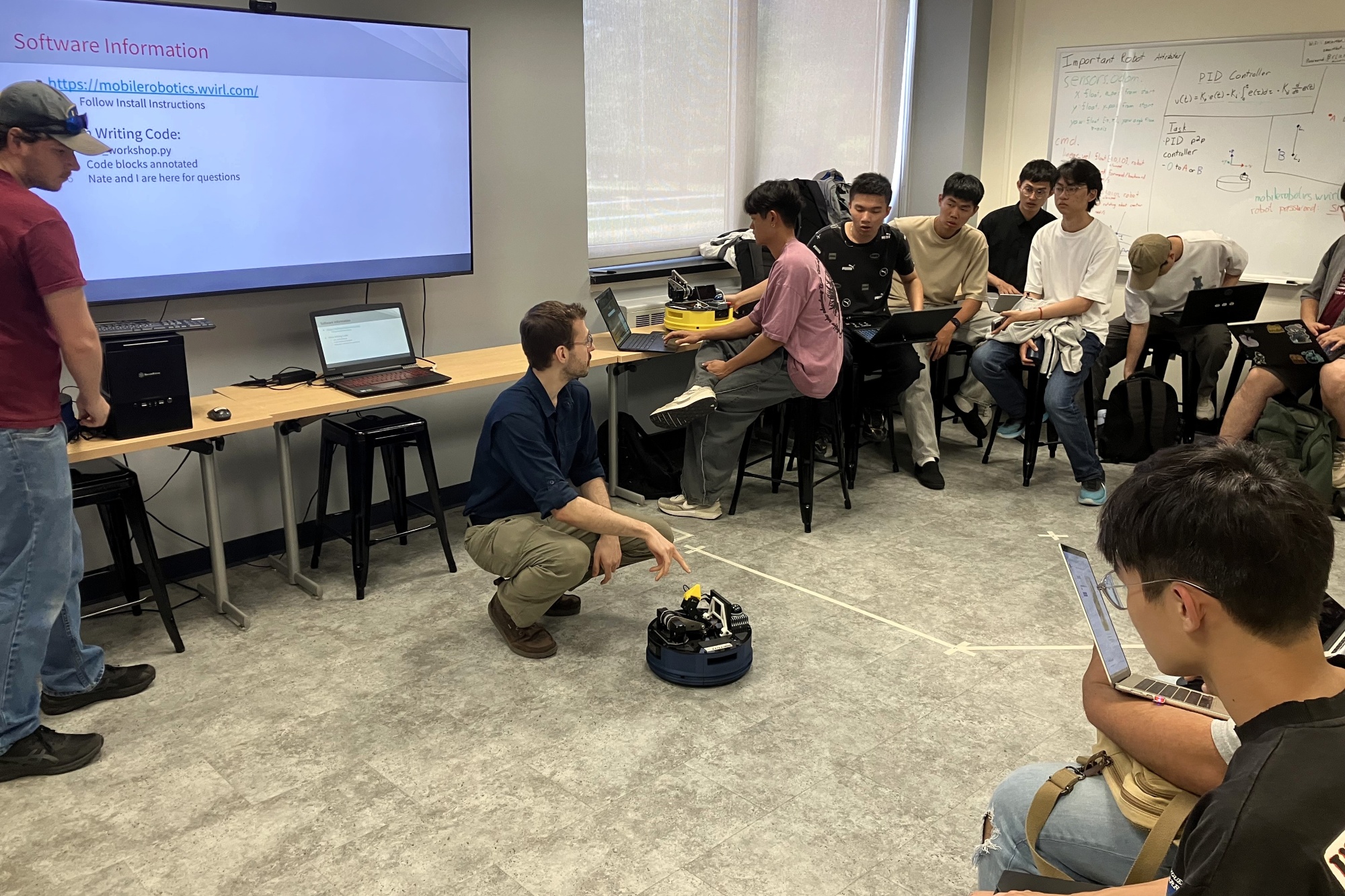
Jalen Beeman explains the practical and programming activities in the Mobile Robotics Lab.

Group photo of the practical demonstration of intelligent mobile robots.
The program also featured a distinguished seminar delivered by Dr. Jason Gross, Chair of the Department of Mechanical, Materials and Aerospace Engineering at WVU, titled "Perception and Localization of Robotic Systems and Unmanned Aerial Systems." Drawing upon WVU's experience in international space robotics competitions, Dr. Gross explained how autonomous robotic systems integrate sensing, localization, navigation, and mission planning to accomplish exploration and object collection tasks in GPS-denied and highly uncertain environments. Following the seminar, student teams began preparing their final project presentations by integrating technologies such as ROS 2, UAV control, computer vision, autonomous navigation, and robotic manipulation. Their project outcomes will be presented on July 22, demonstrating how classroom knowledge has been transformed into innovative engineering applications.
The week's activities concluded with Dr. Andrew Rhodes introducing the student experiential learning projects within the Department of Mechanical, Materials and Aerospace Engineering (MMAE), as well as the High-Altitude Balloon (HAB) program. Students then visited several of WVU's engineering research laboratories, including the Baja SAE off-road vehicle team, the Intelligent Robotics Laboratory, the UAV and Aerospace Research Laboratory, and an electronics soldering workshop. In addition to learning about vehicle design, industrial robotic arms, fixed-wing UAVs, high-altitude balloons, and sounding rocket research, participants assembled and soldered electronic circuit boards for high-altitude balloon data acquisition systems, gaining valuable experience in electronic manufacturing and sensor integration. Through five days of intensive and diverse training, students not only acquired cutting-edge knowledge of intelligent robotics and autonomous systems but also strengthened their interdisciplinary integration skills, teamwork, and global perspectives, laying a solid foundation for future careers in intelligent manufacturing, aerospace engineering, robotics, and artificial intelligence.
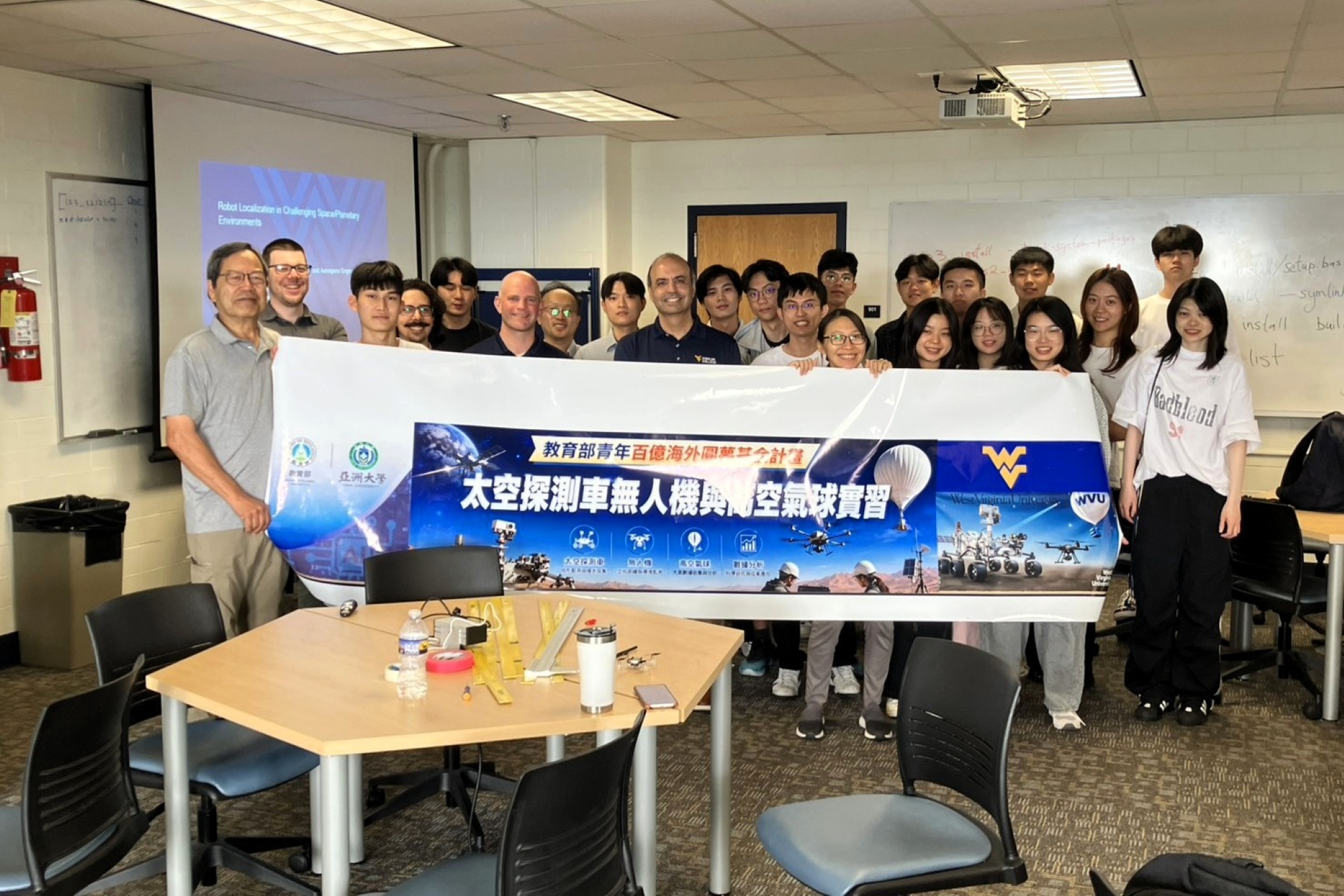
Group photo of the Dean of the College of Engineering and the Chair of the Department of Mechanical, Materials and Aerospace.

Dr. Yu Gu led the students on a tour of NASA's Space Rover Racing Lab.

The students and the balloon satellite sensor module practical finished product are combined.