
28 Asia University Scholars Named Among the World’s Top 2% Scientists
President and Vice President join the list as research strengths span AI, computing, management and health sciences
Asia University (AU), Taiwan, has earned further international recognition for its research, with 28 scholars named in the latest World’s Top 2% Scientists lists, developed by a team of Stanford University researchers and published by Elsevier. Their work spans artificial intelligence, computer science, management and health sciences. Of those recognized, 17 appear on both the single-year and career-long impact lists, reflecting the university’s research achievements across disciplines and its sustained academic influence.
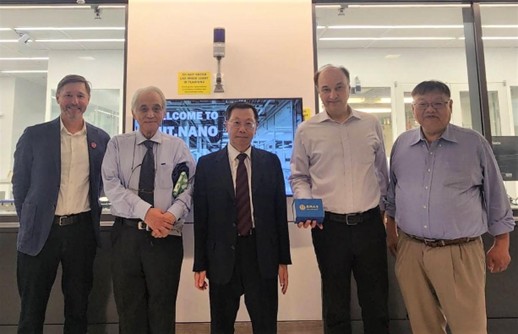
AU President Jeffrey J. P. Tsai (third from right), Chair Professor Kuan-Tsae Huang (far right) and Chair Professor Gene Sheu (fourth from right) visit MIT.nano at the Massachusetts Institute of Technology. They are welcomed by MIT.nano Director Professor Vladimir Bulović (second from right) and Director of Operations Tom Gearty (fifth from right).
According to Taiwan’s Central News Agency, 11 of the recognized scholars are affiliated with AU’s Department of Computer Science and Information Engineering, making it one of the university’s strongest concentrations of scholars on the lists. President Jeffrey J. P. Tsai and Vice President Ren-Hung Hwang are also among the honorees, underscoring the university leadership’s experience in both academic research and higher education administration.
The World’s Top 2% Scientists database assesses research impact using publication citation records from Scopus, authorship contributions and related indicators. It distinguishes between single-year impact, which focuses on research influence within a particular year, and career-long impact, which reflects cumulative influence over a scholar’s career. The database serves as one reference for the international academic community in assessing research impact.
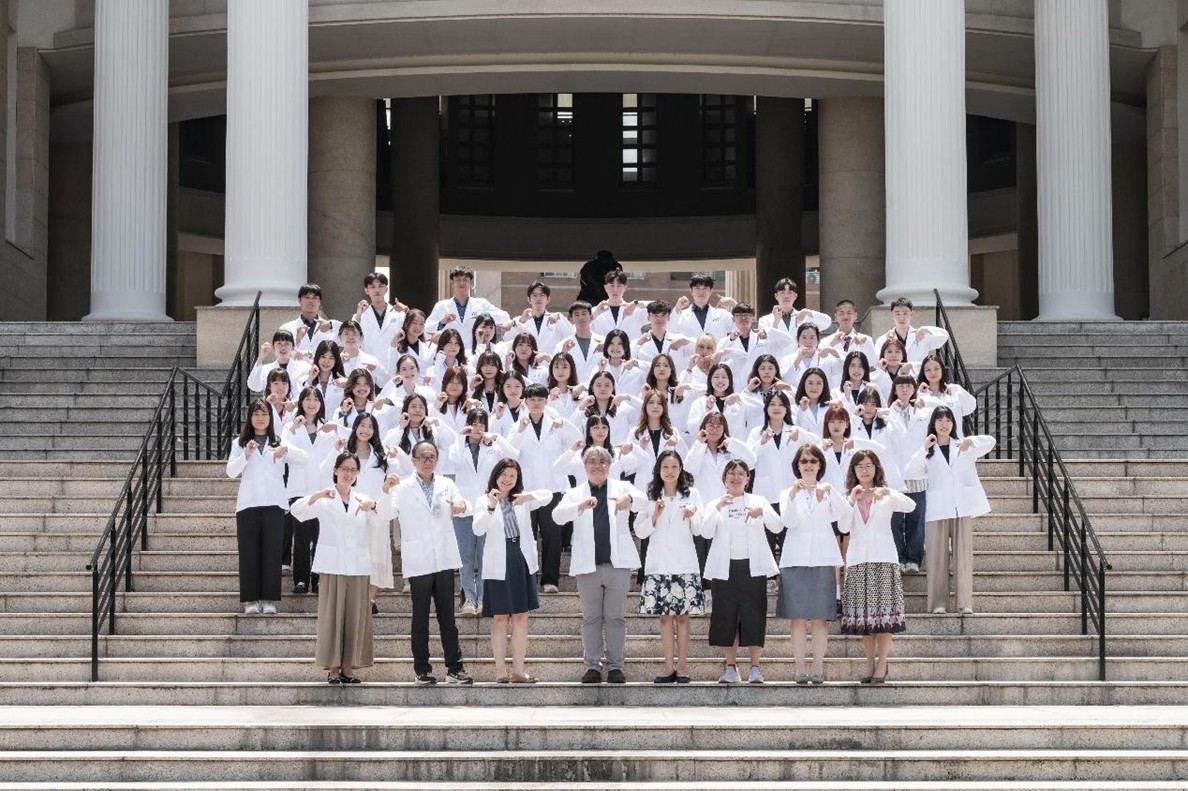
AU’s College of Medical and Health Science achieves strong results in national licensing examinations. This year, the Department of Occupational Therapy recorded a pass rate of 86%, well above the national average of 57%.
AU’s scholars recognized in 2026 represent several colleges, with particularly strong results from the College of Information and Electrical Engineering. The 11 honorees in the Department of Computer Science and Information Engineering are Jeffrey J. P. Tsai, Ren-Hung Hwang, Shyi-Ming Chen, Brij Bhooshan Gupta, Shi-Jinn Horng, Ching-Hsien Hsu, Wen-Lian Hsu, Bing-Jay Sheu, Arbee L. P. Chen, Min-Shiang Hwang and Hsing-Chung Chen. Ching-Wen Lou of the Department of Bioinformatics and Medical Engineering is also on the lists.
In management and finance, the honorees include Ming-Lang Tseng and Shey-Huei Sheu of the Department of Business Administration, and Wing-Keung Wong of the Department of Finance, highlighting AU’s research contributions in these fields.
In health sciences, the recognized scholars include Yi-Lung Chen of the Department of Healthcare Administration; Li-Wei Chou, affiliated with the departments of Physical Therapy and Audiology and Speech-Language Pathology; Mei-Chin Yin and Jeng-Shyan Deng of the Department of Food Nutrition and Healthy Biotechnology; Chich-Hsiu Hung and Li-Chan Lin of the Department of Nursing; and Pi-Chu Lin of the Department of Post-Baccalaureate Nursing.
President Tsai said AU has continued to recruit outstanding scholars from Taiwan and abroad, with AI, quantum technologies, robotics, healthcare and semiconductors as priority areas of development. The university also actively promotes international academic cooperation and has welcomed 21 Nobel laureates for forums and scholarly exchanges. Several AU professors have been elected as fellows or members of international academic organizations, including IEEE, the International Academy of Artificial Intelligence and the European Academy of Engineering. Through these research networks and exchanges, AU is expanding opportunities for faculty and students to engage in frontier research.
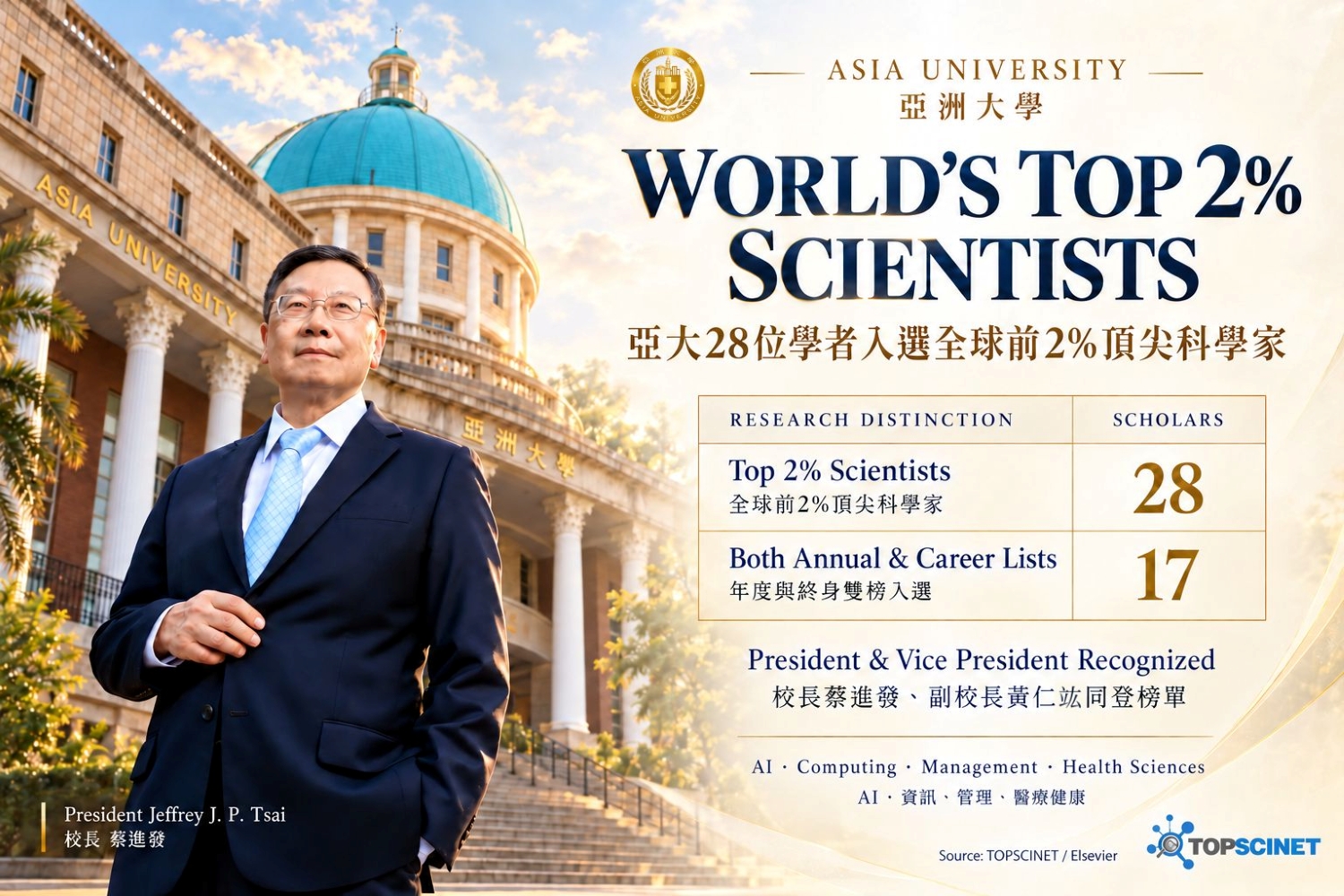
28 Asia University scholars are named among the World’s Top 2% Scientists, including President Jeffrey J. P. Tsai and Vice President Ren-Hung Hwang.